
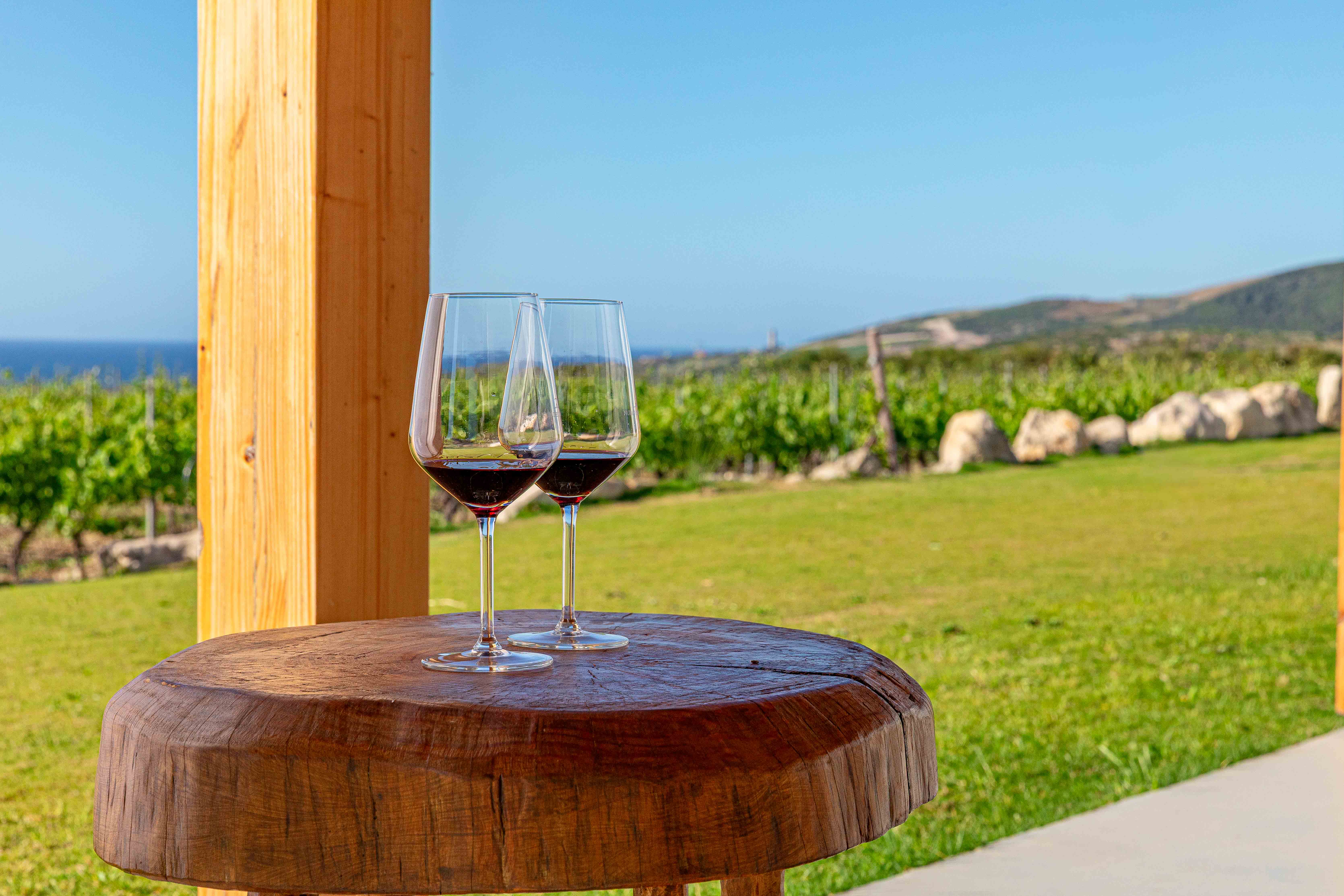
If Sardinia had to choose one wine to stand for the whole island, it would be this one. Cannonau is the red in the tumbler at the family lunch, the bottle opened when guests arrive, the wine poured beside the roast at every village feast. It is warm, deep, a little wild — and it carries more myth on its shoulders than any other Sardinian wine. Some of that myth is true. Some of it is a beautiful story that deserves an honest look.
Here is what Cannonau actually is: where it came from (a genuine archaeological mystery), where and how it grows, what it tastes like, how to serve it — and the truth about the "longevity" legend that has made it briefly famous around the world.
For most of modern history, the story was simple: Cannonau was Grenache — the same grape grown across Spain (as Garnacha) and southern France — brought to Sardinia during the long period of Spanish rule, roughly from the fourteenth century onward. Case closed.
Then, in 2002, archaeologists digging at the nuragic site of Duos Nuraghes near Borore uncovered something that reopened it: hundreds of grape pips, carbonised and preserved, dated to around 1200 BC — some 3,200 years ago. Similar finds have turned up at other Sardinian sites. They prove, beyond doubt, that the Bronze Age nuragic civilisation was already growing vines and making wine on the island, long before any Spanish ship arrived.
That's a remarkable fact. But here's where honesty matters, because the popular version overreaches. Enthusiastic accounts leap from "the nuragic people made wine 3,200 years ago" to "therefore Cannonau is Sardinian, not Spanish, and it's the oldest wine in the Mediterranean." The archaeology doesn't quite support that jump. The ancient pips prove nuragic viticulture; they cannot, on their own, identify the grape variety as Cannonau. Some researchers, examining seeds at sites like Villanovaforru, have described vines with characteristics intermediate between wild vine and something resembling Cannonau — which is suggestive, and genuinely exciting, but not the same as proof.
So where does that leave us? With a real and open question, which is more interesting than a tidy answer. Cannonau is genetically related to Grenache/Garnacha, but centuries of adaptation and mutation mean the two aren't identical. It's entirely possible that Sardinia has an ancient viticultural tradition and that the modern grape has Iberian ties. The truthful summary is this: the old certainty that Cannonau simply "came from Spain" has been shaken by the archaeology, but the claim that it's definitively Sardinian in origin runs ahead of the evidence. Anyone who tells you the matter is settled — in either direction — is telling you more than we actually know.
Whatever its deep origins, Cannonau belongs to the same family as some of the world's most planted red grapes. Known as Grenache in France and Garnacha in Spain, it goes by other names too — Granaccia in Liguria, Tai/Tocai Rosso in the Veneto, Alicante in various places. This matters for the traveller: if you love a Southern Rhône red or a Spanish Garnacha, you already have a way into Cannonau. It's a cousin you haven't met yet.
It's also, by a wide margin, the most widely planted red grape in Sardinia, grown across the whole island but concentrated in the centre — the mountainous heart around Nuoro and the Barbagia, and the region of Ogliastra on the east coast.
Cannonau is a child of heat and light. It ripens late and fully, drinking in the Sardinian sun, which is why the wine is typically warm, generous and naturally high in alcohol. But the best examples aren't just powerful — they're balanced, and that balance comes from the land.
The interior. Away from the coast, the central highlands give Cannonau cooler nights and real altitude. That day-night temperature swing preserves acidity and aromatic complexity that would otherwise be burned away, giving the wine freshness beneath its warmth.
Old bush vines. Much of Sardinia's Cannonau grows as low, free-standing bush vines (alberello), some of them very old, their roots driven deep into poor soil. Low yields and old wood concentrate the fruit — depth you can taste.
A wine of the mountains. Where Alghero's Vermentino and Torbato are wines of the coast, Cannonau is the wine of the interior — of shepherds, high villages and the pastoral Sardinia that the beaches never show you.
Cannonau di Sardegna became a DOC in 1972, and the appellation covers the entire island. A few terms are worth knowing on the label:
Young Cannonau is ruby red, turning garnet with age. The nose is warm and Mediterranean: ripe red and dark berries, dried herbs and macchia (the island's wild scrub), often a spiced, balsamic depth, sometimes a note of tobacco or leather with age.
On the palate it's typically full-bodied and warming, with that generous alcohol, ripe but present tannins, and a savoury, herbal finish. A good one balances its power with freshness rather than simply overwhelming you. Riserva bottles add structure and ageing potential; the best can develop for a decade or more.
Practical notes
Temperature: 16–18°C — slightly below room temperature. Too warm and the alcohol dominates; a touch of coolness keeps it in balance.
Decant: a young, structured Cannonau or a Riserva benefits from 30–60 minutes open, or a decant, to soften and open up.
Glass: a large bowl to gather the aromatics.
Ageing: everyday bottles are for drinking now; Riserva and top single-zone wines reward patience.
Occasions: this is a food wine and a social wine — made for the table, for roast meats, for company.
Here's the story you may have heard. Sardinia's mountainous Ogliastra is one of the world's original "Blue Zones" — regions where people live unusually long, with a notable number reaching a hundred. Cannonau, rich in antioxidants (polyphenols), is often credited as a secret ingredient. The narrative practically writes itself: the locals drink red wine daily and live to be centenarians, therefore the wine must be why.
It's a wonderful story, and there's a grain of real science in it — Cannonau does tend to be high in polyphenols, and the Ogliastra longevity is well documented. But the causal leap is where it falls apart, and it's worth being clear-eyed about it.
Longevity in these communities is the product of many interwoven factors: a largely plant-based, seasonal diet; constant natural movement through a hard, hilly landscape; strong family and community bonds; low stress; genetics; and, yes, moderate wine drunk with food and company rather than alone. No single glass explains a hundred-year life. Pulling the wine out and calling it the cause is exactly the kind of tidy shortcut that makes for good headlines and bad reasoning.
So drink Cannonau because it's genuinely delicious, because it's the honest expression of an ancient wine culture, and because it belongs on the table with people you like. That's more than reason enough — and it happens to be the part that's actually true. Treating it as a health supplement misses both the science and the point.
(Note: this is cultural and historical context, not health or medical advice.)
Vermentino and Torbato are the wines of the Sardinian coast — bright, saline, made for the sea. Cannonau is something else: the wine of the interior, of the mountains and the shepherds, of the long lunch that goes into the afternoon. It carries the island's oldest wine story, a genuine archaeological mystery, and a myth it's better off without. Strip away the health-supplement hype and what's left is simply one of the Mediterranean's great, characterful reds — warm, ancient and unmistakably Sardinian. Pour a glass beside a plate of roast pork, and you're not drinking a superfood. You're drinking Sardinia.
We'll take you to discover producers and wineries. Private transfer included.
Discover our experiencesCannonau is Sardinia's flagship red grape, related to Grenache/Garnacha. It was long thought to have arrived from Spain, but Bronze Age grape pips found at nuragic sites show winemaking existed on the island over 3,000 years ago. Those finds prove ancient Sardinian viticulture, though they can't by themselves confirm the grape was Cannonau — so its precise origin remains genuinely debated.
They're closely related and genetically similar, but not identical. Cannonau is known as Grenache in France and Garnacha in Spain, but centuries of adaptation and mutation in Sardinia have made it distinct.
Cannonau is high in antioxidants and is often linked to the long lives of people in Sardinia's Ogliastra "Blue Zone." But longevity there results from many factors — diet, constant movement, genetics, strong social bonds — not a single food or drink. Enjoy Cannonau for its flavour, not as a health remedy.
Roast and grilled meats above all — especially Sardinian porceddu (roast suckling pig) — plus hard cheeses, game and hearty dishes. Its body and savoury character are built for rich, traditional food.
Around 16–18°C, slightly below room temperature. This keeps its naturally high alcohol in balance and lets the aromatics open. A young or Riserva bottle benefits from decanting.
.jpg)
Sardinia's roast suckling pig and its great red wine were made for each other. Here's why.
Read the article→No signposted routes, no walk-ins: wine tasting in Sardinia works differently. How to book it, what to expect, and the problem nobody plans for.
Read the article→We take you directly to the producers, with private transfer included and in small groups.
© 2026 Henosis. Tutti i diritti riservati.
Henosis